Java4Shell (CVE-2026-114938): Patch Your JVMs or Flip One Flag Today
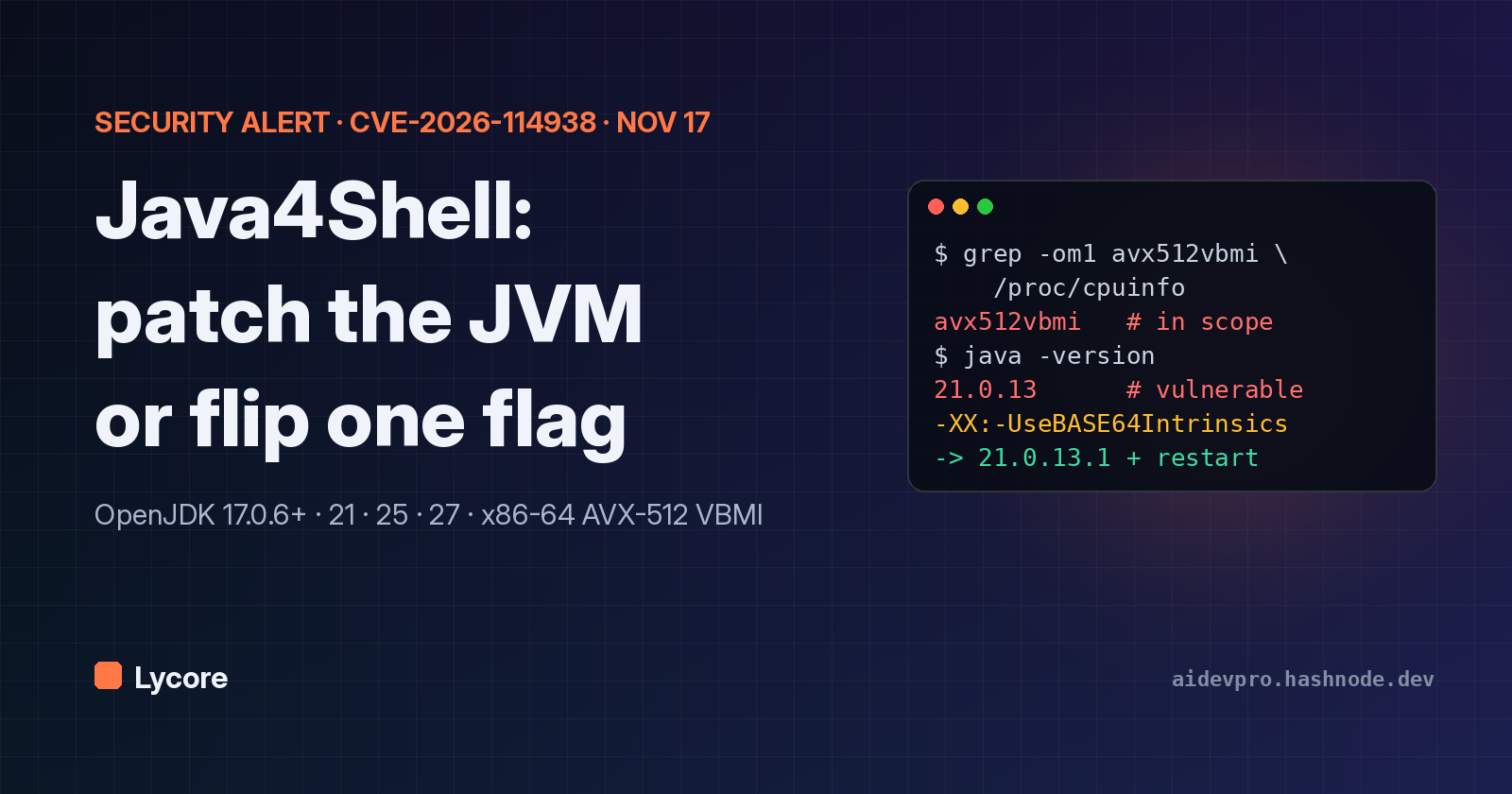
On November 17, 2026, the OpenJDK project and Oracle shipped fixes for CVE-2026-114938, a memory-corruption bug in the x86-64 Base64 decoder that its finders call Java4Shell (OpenJDK advisory; Calif). The same day, CISA told organizations to patch immediately and to start with internet-facing systems (CISA).
This is not just a Java-shop problem. Python, Django and Node teams usually still run Java somewhere: an identity server, CI, search, a broker.
Below: what is confirmed, what is affected and what is not, a 10-minute checklist, commands to find every JVM you run, the one-flag workaround and how to prove it took effect. Facts come from the sources linked inline. The section marked Our take is opinion.
TL;DR
- What: an out-of-bounds heap write in HotSpot's AVX-512 VBMI Base64 decoding intrinsic. Malformed Base64 input with a stray
=makes the routine compute a negative output length. That turns into a full 64-byte masked store, which writes past the end of the output array before Java rejects the input (Calif; Datadog Security Labs). - Affected: OpenJDK 17.0.6 and later on lines 17, 21, 25 and 27, plus builds made from it (Temurin, Corretto, Zulu, Microsoft, Red Hat, Oracle Java SE and others), only on x86-64 CPUs with AVX-512 VBMI (JFrog; Calif).
- Not affected: ARM64. Standard Java 8 and 11 (Red Hat). x86-64 CPUs without AVX-512 VBMI.
- Fixed (Oracle numbering): 17.0.21.1, 21.0.13.1, 25.0.5.1, 27.0.1.1 (JFrog; Datadog). Other vendors number builds differently.
- Workaround: start the JVM with
-XX:-UseBASE64Intrinsics(narrowest), or-XX:UseAVX=2on x86-64 only (Red Hat). - Severity: 9.2 under CVSS 4.0 (Calif's score). 8.1 under CVSS 3.1 in the OpenJDK/Oracle matrix, with high attack complexity (SecurityWeek).
- Exploitation: Cisco Talos had not seen in-the-wild exploitation when it published, but expects probing to start soon (Talos). Aikido reported no confirmed exploitation and no CISA KEV listing as of November 18 (Aikido).
The 10-minute checklist
- Is the host x86-64 with AVX-512 VBMI? Run
grep -om1 -E 'avx512[_]?vbmi' /proc/cpuinfo. No output means that CPU is not in scope. ARM64 hosts are not in scope at all. - List every JVM, not just the one on your
PATH. That includes JDKs bundled inside products and base images. CISA warns that these "may not appear as separate entries in software inventories" (CISA). - Check versions. Anything on 17.0.6+, 21, 25 or 27 below the fixed build is in scope. Standard 8 and 11 are not.
- Rank by exposure. Internet-facing services first, then login and identity services, since they decode Base64 credentials and tokens before authentication finishes (Red Hat).
- Patch where a fixed build exists (Oracle, Amazon Corretto). Rebuild images and restart processes.
- Elsewhere, add
-XX:-UseBASE64Intrinsicsand restart. Then check the running process withjcmd <PID> VM.flags -all. - Watch for unexpected JVM crashes and odd Java child processes (CISA).
What happened, in order
- November 17, 2026, 1:00 PM PT (Nov 18, 02:00 PKT): OpenJDK published its advisory and Oracle released its patch, according to Calif (Calif). The OpenJDK advisory lists ten OpenJDK CVEs in this release, with CVE-2026-114938 at the top: component
hotspot/compiler, CVSS 3.1 score 8.1, affecting 17, 21, 25 and 27 but not 8 or 11 (OpenJDK). - November 17: Calif, the research firm whose researcher Quang Luong found the bug, published its write-up. SecurityWeek says Calif went public "after news of the flaw surfaced ahead of the coordinated disclosure" (SecurityWeek).
- November 17: CISA issued "Critical Java Vulnerability Requires Immediate Patching" (CISA). Red Hat opened bulletin RHSB-2026-018, rated it Critical, and said it is "expediting the release of fixes" for RHEL 8, 9 and 10 and its OpenJDK 17, 21 and 25 builds (Red Hat). Amazon Linux shipped fixed Corretto packages for 17, 21, 25 and 27 the same day (Amazon Linux Security Center).
- November 18: SecurityWeek reported VulnCheck's assessment: crashing a vulnerable JVM is easy once you find a reachable entry point, but full RCE takes per-target heap work (SecurityWeek).
How the bug works (short version)
Java's java.util.Base64.Decoder is pure Java on paper. In practice, HotSpot's C2 JIT compiler swaps hot decode loops for hand-written machine code called intrinsics. On x86-64 CPUs with AVX-512 VBMI, it picks an AVX-512 routine that decodes 64 input bytes per step (Datadog).
The bug is in the code that handles the last fragment of input, the part shorter than 64 bytes:
- The routine works out the fragment's output size as
(len / 4) * 3. For a lone=, that is 0. - Because the fragment ends in
=, it subtracts one for padding. Nothing checks for a negative result, so the count becomes -1 (Datadog). - The count builds a store mask with the
BZHIinstruction.BZHIreads only the low byte of the count, and for -1 that is 255. A count of 64 or more leaves all 64 mask bits set, so the masked store writes all 64 bytes (Datadog; Calif).
Calif's trigger is 64 A characters followed by one =. For that 65-character input, OpenJDK allocates a 50-byte result array, and the store sends 62 bytes past its end. On older OpenJDK 17 builds the trigger is 128 As plus =, because the length threshold for this code path is higher (Calif).
Two details matter:
- The exception does not undo the damage. The decoder still throws
IllegalArgumentExceptionfor the bad input. By then the native code has already written outside the array, so catching the exception leaves the corruption in place. In Datadog's test, the JVM crashed later, during garbage collection, far from the decode call (Datadog). - The overwrite bytes are mostly fixed. Only where the write lands can be controlled. Much of the excess output is the repeating pattern
69 a6 9a(Datadog). Calif turned this into a heap-read primitive it calls JavaBleed (Heartbleed-style leaks of heap data that "may hold PII, private keys, other secret keys, and tokens"). It then reached code execution via remote heap grooming (Calif).
Datadog found that in the 17.0.6 build it tested, the AVX-512 path handles Base64.getDecoder() and Base64.getUrlDecoder(), but Base64.getMimeDecoder() bypasses it. Libraries that use their own Base64 code, or reject bad values before calling the JDK decoder, may not be exposed (Datadog).
What is affected
All of these must be true for a system to be exploitable (Red Hat):
- Java version: OpenJDK 17.0.6 or later on 17, 21, 25 or 27, before the vendor's fixed build. Aikido also lists the end-of-life lines 18–20, 22–24 and 26 as affected, with no fixes; the advice is to move to a supported line (Aikido).
- CPU: x86-64 with AVX-512 VBMI. Red Hat names Intel Ice Lake, Sapphire Rapids, Emerald Rapids and Granite Rapids, and AMD Zen 4, Zen 5 and Zen 6 (Red Hat).
- JVM flags: not started with
-XX:UseAVX=2or lower, and Base64 intrinsics not turned off. - Data path: attacker-controlled Base64 reaches
java.util.Base64.Decoder. Red Hat names HTTP Basic credentials, SAML artifacts, CSRF tokens and MIME encoded words as common sources, "all of which are frequently decoded before authentication completes" (Red Hat).
No special setup is needed: "The accelerated code path is selected automatically whenever the JVM runs on a CPU reporting AVX-512 VBMI support" (Red Hat).
Distributions. Calif lists Amazon Corretto, Eclipse Temurin, Microsoft Build of OpenJDK, Azul Zulu, BellSoft Liberica, SAP SapMachine, Red Hat OpenJDK, Oracle OpenJDK, Oracle Java SE and Oracle GraalVM for JDK as vulnerable because they are built from OpenJDK. Oracle also lists 8u511b33-perf, the Java SE 8 Enterprise Performance Pack build, as vulnerable, the one Java 8 exception (Calif; Aikido).
Cloud instances. Red Hat says the instance families "most likely to be affected" include AWS C6i/M6i/R6i and C7i/M7i/R7a, GCP C3/C3D/C4/C4D/N4/N4D/M3/M4, and Azure Dsv5/Dsv6/Dasv6/Dasv7 and related D-series v5–v7 SKUs (Red Hat). Confirm with the CPU check below.
Applications Calif tested. In its initial tests, Calif reports RCE against these products in their default configurations (Calif):
| Pre-auth RCE (Calif) | Post-auth RCE (Calif) |
|---|---|
| Keycloak | Apache Kafka Broker |
| Atlassian Jira | Apache Solr |
| Atlassian Confluence | Elasticsearch |
| JFrog Artifactory | Gerrit |
| Jenkins | Spinnaker |
| PingFederate |
Calif says the lists are "non-exhaustive". It also demonstrated RCE in sample apps built on Apache Struts and Spring Boot, and describes a client-side exploit shared by samczsun: a Java program that opens a TLS connection to a malicious server can be compromised "even if it exposes no service of its own" (Calif). These are researcher claims, not vendor statements, and the product exploit chains are still private (SecurityWeek).
What is not affected
- ARM64 / aarch64 JVMs, including Graviton and Apple Silicon. They never run the vulnerable x86 routine (Datadog; JFrog).
- x86-64 CPUs without AVX-512 VBMI, which Red Hat describes as processors older than Intel Ice Lake or AMD Zen 4 (Red Hat).
- 32-bit x86 (i386/i686) JVMs, per JFrog (JFrog).
- Standard OpenJDK 8 and 11, which lack the vulnerable code path (Red Hat). The Oracle
8u511-perfbuild noted above is the exception. - OpenJDK 17.0.0–17.0.5, which predate the affected range (Datadog). That is no reason to stay on them.
Note that the November release fixes nine more OpenJDK CVEs, and several do affect 8 and 11 (OpenJDK). "Not affected by Java4Shell" does not mean "skip this update".
Who must act
- Anyone running Keycloak, Jira, Confluence, Artifactory, Jenkins or PingFederate on x86-64 cloud or on-prem hardware: these are on Calif's pre-auth list, and identity and CI systems usually sit close to your secrets.
- Platform and DevOps teams that own base images. A fixed host JDK does nothing for a container that ships its own runtime. Rebuild, redeploy and restart (Datadog; Red Hat).
- Teams running Kafka, Elasticsearch or Solr on affected CPUs: Calif lists these as post-auth targets.
- Anyone with Java clients that talk TLS to servers they don't control, given the client-side exploit Calif describes.
Vendor patch status (as of November 18, 2026)
| Vendor / build | Status | Source |
|---|---|---|
| Oracle Java SE | Fixed: 17.0.21.1, 21.0.13.1, 25.0.5.1, 27.0.1.1 (Datadog lists +4 builds) |
Datadog, JFrog |
| Amazon Corretto / Amazon Linux | Fixed packages for 17, 21, 25, 27 on AL2 (17 only), AL2023 and AL2027 Preview, released Nov 17 | ALAS |
| Corretto build numbers | 17.0.21.1.2, 21.0.13.1.2, 25.0.5.1.2, 27.0.1.1.4 | Aikido |
| Red Hat (RHEL 8/9/10, Red Hat build of OpenJDK 17/21/25, UBI images) | Fixes being expedited; bulletin "Ongoing" | Red Hat |
| Eclipse Temurin (Adoptium) | No confirmed fix at Aikido's last check; 17.0.21+9, 21.0.13+9, 25.0.5+8 listed as vulnerable | Aikido |
Azul Zulu, Microsoft, Liberica, SapMachine, distro openjdk-* packages |
Listed as affected; we did not find confirmed fixed builds in our sources. Check each vendor. | Calif |
SecurityWeek reports Endor Labs' finding that, as of November 17, the fix was not yet in the public OpenJDK 17, 21 and 25 update repositories. (SecurityWeek). This table will go stale quickly, so check your vendor's page before you act on it.
One more wrinkle: Amazon rates the CVE 8.8 Important. Its CVSS 3.1 vector has low attack complexity and needs low privileges, and its description says unauthenticated users can crash the JVM while code execution needs an authenticated low-privileged user "in certain application environments" (ALAS). That reads very differently from Calif's pre-auth RCE claims and Oracle's 8.1 with high complexity. Plan for the worst case that applies to your apps.
Step 1: Check the CPU
Datadog's check, which matches either spelling of the flag:
grep -om1 -E 'avx512[_]?vbmi' /proc/cpuinfo
Calif's stricter version lists every feature the routine needs. "The output must include all four flags" (Calif):
grep -m1 '^flags' /proc/cpuinfo | tr ' ' '\n' \
  | grep -E '^(avx512f|avx512bw|avx512vbmi|bmi2)$'
Inside a container, /proc/cpuinfo shows the host CPU, so running this in a pod tells you about the node. On a fleet, run it everywhere:
# Ansible ad-hoc example
ansible all -m shell -a "grep -c avx512vbmi /proc/cpuinfo || true"

# Kubernetes: one throwaway pod per node is the honest way; or check node labels
kubectl get nodes -o custom-columns=NAME:.metadata.name,ARCH:.status.nodeInfo.architecture
Any arm64 node in that last command is out of scope for this CVE.
Step 2: Find every JVM
The java on your PATH is often not the one your service uses. Find the binaries:
# Every java binary on the host
sudo find / -xdev -type f -name java -path '*/bin/java' 2>/dev/null \
  | while read -r j; do echo "== $j"; "$j" -version 2>&1 | head -2; done
Then check what is actually running. Datadog says to inspect the process "rather than relying on the Java installation found on your shell's path" (Datadog):
for pid in $(pgrep -x java); do
  exe=$(sudo readlink -f /proc/$pid/exe)
  echo "== PID $pid  $exe"
  sudo "$exe" -version 2>&1 | head -1
done

# With a JDK that has jcmd (run as the process owner):
jcmd <PID> VM.version
Containers. Image metadata often shows the Java version. Then confirm by running the image's own java:
# Version hint from image env (official eclipse-temurin images set JAVA_VERSION)
docker image ls --format '{{.Repository}}:{{.Tag}}' | grep -v '<none>' | while read -r img; do
  v=$(docker image inspect --format '{{range .Config.Env}}{{println .}}{{end}}' "$img" | grep -E '^JAVA_VERSION=')
  [ -n "$v" ] && echo "$img  $v"
done

# Ground truth: run the image's own java (skip images without one)
docker run --rm --entrypoint java <image> -version

# Kubernetes: list all images you're running, then check each
kubectl get pods -A -o jsonpath='{range .items[*]}{range .spec.containers[*]}{.image}{"\n"}{end}{end}' | sort -u
If you use an SBOM-based scanner (Xray, Grype, Trivy, Datadog CSM and the like), check that its database knows this CVE before you trust a clean result. JFrog and Datadog both say their products already flag it (JFrog; Datadog).
Bundled runtimes. Some products ship their own JDK inside the install directory. The find above catches them on hosts. Red Hat's advice for these is to "apply the mitigation flag or update via the product vendor's supported path rather than patching the JVM independently" (Red Hat).
Step 3: Patch
- Oracle Java SE: move to 17.0.21.1, 21.0.13.1, 25.0.5.1 or 27.0.1.1.
- Amazon Linux / Corretto:
sudo dnf update 'java-*-amazon-corretto*'on AL2023 (yumon AL2), then restart services. The fixed advisories are listed on the ALAS page. - RHEL / UBI: watch RHSB-2026-018 for errata. Once they land, update the
java-*-openjdkpackages and rebuild UBI-based images (Red Hat). - Temurin and others: use the workaround below until the vendor ships a fixed build, then move to it.
- Containers: bump the base image digest, rebuild, redeploy. A running pod keeps its old JVM until it restarts.
Step 4: The workaround, and how to prove it works
Every source we read gives two options (JFrog; Datadog; Red Hat):
-XX:-UseBASE64Intrinsicsturns off only the hardware-accelerated Base64 code. Red Hat calls this "the preferred option", and Datadog calls it "the narrower workaround".-XX:UseAVX=2turns off AVX-512 everywhere in the JVM, which affects more than Base64. Use it on x86-64 only. ARM64 JVMs don't recognize it and fail to start withUnrecognized VM option 'UseAVX=2'(JFrog).
Datadog confirmed that both flags stopped the out-of-bounds writes in its tests. JFrog warns that both "may cause performance degradation", so monitor after you apply one.
The quickest way to apply the flag everywhere is JAVA_TOOL_OPTIONS, which the JVM reads at startup no matter which launcher script runs it:
# systemd drop-in for a service
sudo systemctl edit myservice
#   [Service]
#   Environment="JAVA_TOOL_OPTIONS=-XX:-UseBASE64Intrinsics"
sudo systemctl restart myservice
# Kubernetes container spec
env:
  - name: JAVA_TOOL_OPTIONS
    value: "-XX:-UseBASE64Intrinsics"
# Dockerfile, until the fixed base image is available
ENV JAVA_TOOL_OPTIONS="-XX:-UseBASE64Intrinsics"
Watch out for two things. If the service already sets JAVA_TOOL_OPTIONS, append to it, don't replace it. And many products have their own JVM options hook (for example JAVA_OPTS style variables or a jvm.options file). Check your product's docs if you prefer to use those.
For shared settings, prefer -XX:-UseBASE64Intrinsics. The sources only warn about UseAVX=2 breaking ARM64 startup, but we have not verified the Base64 flag on every platform, so start one ARM64 instance with it before pushing it fleet-wide.
Verify on the binary:
java -XX:-UseBASE64Intrinsics -XX:+PrintFlagsFinal -version 2>/dev/null \
  | grep -E 'UseBASE64Intrinsics|UseAVX '
You want UseBASE64Intrinsics to show false.
Verify on the running process. This is the check that counts:
jcmd <PID> VM.flags -all | grep -E 'UseBASE64Intrinsics|UseAVX '
Datadog says to confirm "that the process reports UseBASE64Intrinsics = false or UseAVX = 2, depending on the workaround selected" (Datadog). If you used JAVA_TOOL_OPTIONS, the JVM also prints a Picked up JAVA_TOOL_OPTIONS: ... line to stderr at startup, which you can grep for in service logs.
Treat the flag as temporary. Red Hat says to "apply the permanent OpenJDK fix once available and remove the workaround flag" (Red Hat).
Step 5: Compensating controls and detection
If you can't restart a JVM today, CISA suggests restricting and validating Base64 input at the application boundary, enforcing input-size limits, and limiting unauthenticated access (CISA). Practical versions of that:
- Put identity and CI admin UIs behind VPN while you patch.
- If your WAF or IDS supports it, turn on rules for malformed Base64. Talos released Snort 2 SIDs 1:67502–1:67513 and Snort 3 SIDs 1:301754 and 1:67502–1:67513, and says its free community rules are live (Talos). Talos also notes the rules cover "specific HTTP request fields", so they don't catch every path.
- Alert on JVM crash files (
hs_err_pid*.log) and unexpected restarts of Java services. Datadog's test showed the corruption can crash the JVM later, during garbage collection, and CISA lists unexpected JVM crashes as an indicator (Datadog; CISA). - Alert on Java processes spawning shells. Talos points to Splunk detections for application servers spawning shells (Talos).
# Quick sweep for recent JVM crash logs
sudo find / -xdev -name 'hs_err_pid*.log' -mtime -3 2>/dev/null
Notes for Python, Django and Node shops
You may not write Java, but you probably run it:
- Keycloak (SSO for your Django/Node apps): on Calif's pre-auth RCE list (Calif). If it runs on an Ice Lake+ or Zen 4+ x86 instance, it is your top priority. It sits on the login path and holds signing keys. Check which JDK your Keycloak image or install ships, then patch it or add the flag.
- Jenkins: on Calif's pre-auth list. Jenkins controllers usually hold deploy credentials, so treat this like a credential exposure risk. Check the controller and any Java-based agents.
- Elasticsearch / OpenSearch: Elasticsearch is on Calif's post-auth list. OpenSearch is not named in any source we read, so check whether your OpenSearch nodes run an affected JDK on an affected CPU, rather than assuming either way. Search clusters often use a JDK bundled with the product, so check the bundled one, not the host's.
- Kafka: Apache Kafka Broker is on Calif's post-auth list. Check broker JDK versions and who can authenticate to your brokers. Also check if Connect workers, Schema Registry or other Java components in your stack run affected JDKs. No source names them.
- Anything else on the JVM (Zookeeper, Trino, Spark, Flink, Logstash, Nexus, SonarQube, a Spring Boot microservice from another team): not named in our sources. Check if it runs on an affected JDK and CPU, and whether it decodes Base64 from untrusted input. Calif says ordinary features like login and file uploads can reach the decoder (Calif).
Your Python and Node code is not affected by this CVE. CPython's base64 module and Node's Buffer are separate implementations. The risk comes from the Java services those apps depend on.
Exploitation status and what is still unknown
- In the wild: none confirmed as of November 18, and not in CISA KEV (Talos; Aikido). That can change at any time, so check the KEV catalog yourself.
- Public exploit code: Calif's public PoC shows the memory corruption but not code execution. Its product-specific chains "stay private until everyone has had a chance to upgrade" (SecurityWeek).
- Difficulty: Datadog says denial of service is "the more readily achievable impact", and that reliable RCE needs work tailored to each application and JVM (Datadog). VulnCheck built a full RCE exploit but doesn't expect the bug to be "easily or widely exploitable" (SecurityWeek).
- AI's role: Calif says Quang Luong found the bug in about an hour with an AI coding agent, built the first working exploit two hours later, and spent less than $200 on tokens (Calif). Others have not independently checked that claim.
- Unknown: exact fixed build numbers for Temurin, Zulu, Microsoft and the distro packages. Whether named products will ship their own advisories or bundled-JDK updates. How broad the TLS client-side vector is.
Our take
This section is opinion, not reporting.
The flag is cheap insurance. Use it now and keep patching. For most of our readers' Java sidecars (an identity server, a CI controller), Base64 decoding is not the bottleneck. Adding -XX:-UseBASE64Intrinsics is one environment variable and one restart. Waiting for Temurin, Red Hat or your product vendor could take days. We'd flag internet-facing x86 boxes today.
"High attack complexity" is not "low priority." Every source agrees that RCE takes per-target work. But a crash only takes a reachable decoder and a 65-byte string, and a crash loop on your SSO server is an outage for every app behind it. Calif's JavaBleed primitive, if it works as described, leaks heap data before any code runs. For identity servers, that alone is reason enough to act.
Inventory is the real lesson. CISA's note that JVMs "may not appear as separate entries in software inventories" is the most useful sentence in this whole news cycle. If the find-every-JVM step took you more than ten minutes, put a recurring check in CI: generate an SBOM per image and alert on runtime versions.
Calif's "vibe-uncoding" point is fair. A hand-tuned decoder that helps a few high-volume apps ships to everyone (Calif). We wouldn't disable intrinsics wholesale, but it's worth asking which speed-ups are worth their attack surface.
Open question for readers
Here's the trade-off we'd like to hear about. Do you push -XX:-UseBASE64Intrinsics to every x86 JVM today, or wait a few days for vendor builds and patch once?
The flag means a fleet-wide config change and a restart now, plus a second restart later for the real fix and to remove the flag. It may also cost some performance in Base64-heavy services, and it's another setting you have to remember to remove. Waiting means one clean rollout, but you stay exposed while exploit chains are written and probing starts.
Where did you land, and was it different for internet-facing services and internal ones? If you've measured the flag's cost on a real workload, please share numbers.
Sources
- OpenJDK Vulnerability Group, "OpenJDK Vulnerability Advisory: 2026/11/17": https://openjdk.org/groups/vulnerability/advisories/2026-11-17
- CISA, "Critical Java Vulnerability Requires Immediate Patching" (Nov 17, 2026): https://www.cisa.gov/news-events/alerts/2026/11/17/critical-java-vulnerability-requires-immediate-patching
- Calif, "Java4Shell: Write once, RCE everywhere": https://calif.io/java4shell/
- JFrog Security Research, "Java4Shell: What We Know About the Critical OpenJDK RCE Vulnerability" (Nov 17, 2026): https://research.jfrog.com/post/java4shell-vulnerability/
- Datadog Security Labs, "Java4Shell: Remote Code Execution in OpenJDK (CVE-2026-114938)" (Nov 17, 2026): https://securitylabs.datadoghq.com/articles/java4shell-remote-code-execution-in-openjdk-cve-2026-114938/
- SecurityWeek, "Java4Shell Vulnerability Puts Many Enterprise Applications at Risk of Takeover" (Nov 18, 2026): https://www.securityweek.com/java4shell-vulnerability-puts-many-enterprise-applications-at-risk-of-takeover/
- Red Hat, RHSB-2026-018 (created Nov 17, 2026, status Ongoing): https://access.redhat.com/security/vulnerabilities/RHSB-2026-018
- Amazon Linux Security Center, CVE-2026-114938: https://explore.alas.aws.amazon.com/CVE-2026-114938.html
- Cisco Talos, "CVE-2026-114938: Critical vulnerability in OpenJDK JAVA" (Nov 17, 2026): https://blog.talosintelligence.com/java4shell/
- Aikido Security, "Java4Shell: RCE flaw in OpenJDK's Base64 decoder, with affected versions and fix" (updated Nov 18, 2026): https://www.aikido.dev/blog/java-17-rce-vulnerability-cve-2026-114938
About the author
- Custom software & AI development company. We build production-ready AI integrations, mobile apps, and web platforms for businesses that want real results. lycore.com
Comments
Join the discussionNo comments yet. Be the first to comment.