NGINX2Root: Patch nginx to 1.30.7/1.31.9 or Turn Off HTTP/2 Today
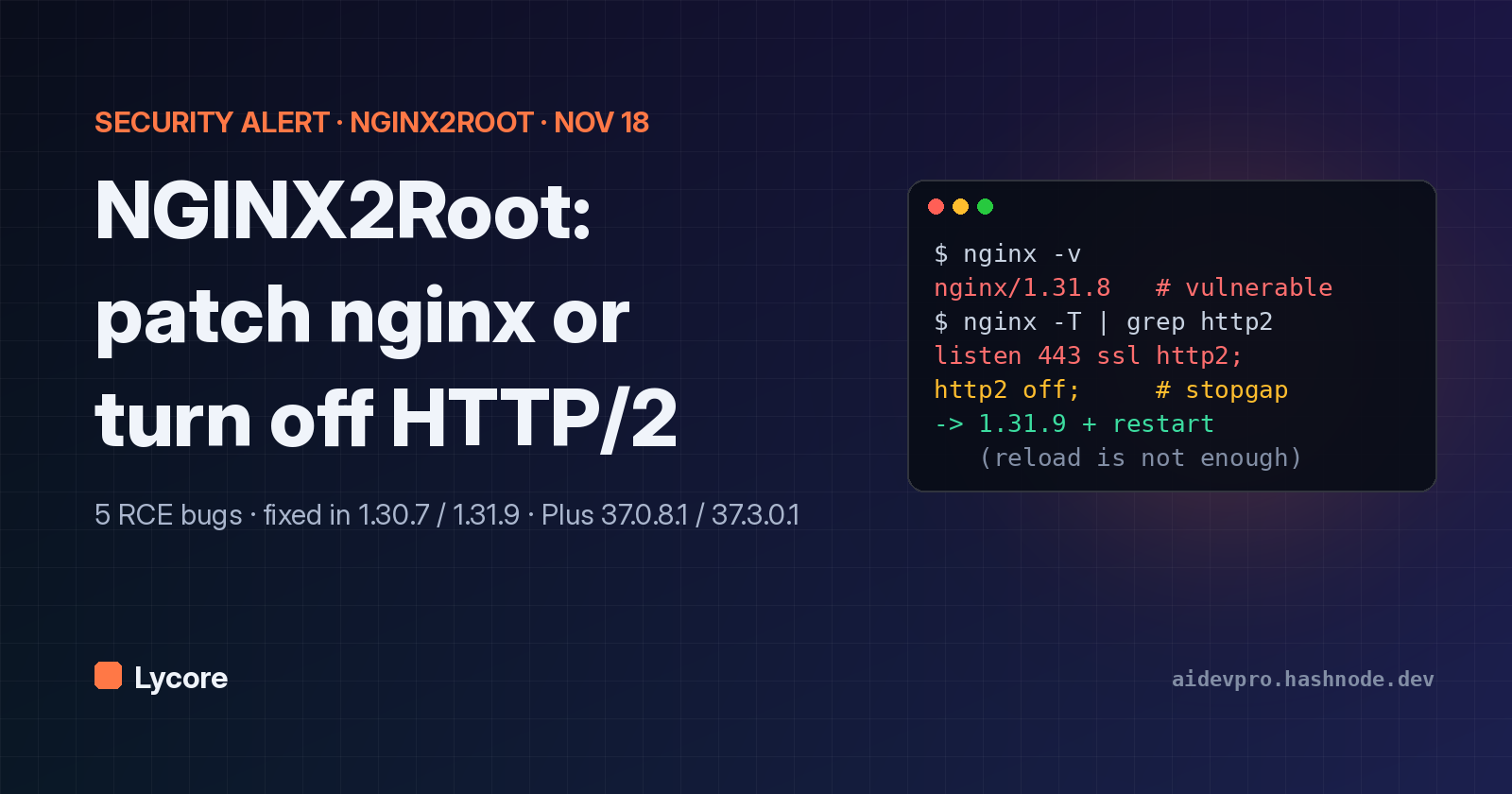
On November 18, 2026, F5 and the nginx project released nginx 1.30.7 (stable) and 1.31.9 (mainline), fixing ten security issues (nginx.org security advisories; CHANGES; CHANGES-1.30). Five of them are memory-corruption bugs that the research firm Xint, which reported four of the five, named NGINX2Root (Xint). F5 rates each of the five 8.1 (High) under CVSS 3.1 and 9.2 (Critical) under CVSS 4.0 (Censys; AlmaLinux). CERT-EU's advisory the same day says all five "allow an unauthenticated remote attacker to execute code with the privileges of the NGINX worker process" (CERT-EU 2026-022).
If you run Django, FastAPI, Flask, Rails or Node behind nginx, this is about your front door, not your app code. Wiz notes that "applications with secure code can still be exposed" (Wiz).
Below: what is confirmed, who is affected and who isn't, a 10-minute checklist, commands to check your config and packages, the HTTP/2 kill switch and how to prove it worked. Facts come from the sources linked inline. The section marked Our take is opinion.
TL;DR
- What: five independent bugs, each tied to a different nginx feature: HTTP/2 flow control (CVE-2026-123007), HTTP/2 when proxying (CVE-2026-123633), HTTP/3 when proxying (CVE-2026-121810), the resolver with subrequests (CVE-2026-123634), and the mail proxy (CVE-2026-113425) (nginx.org; Censys).
- Most urgent: CVE-2026-123007. Its only precondition is HTTP/2 on a listening port (CERT-EU). It affects every release from 1.9.5 (2015) to 1.31.8. Wiz got code execution against nginx serving plain static files (Wiz).
- Fixed in: nginx OSS 1.30.7 and 1.31.9. NGINX Plus 37.0.8.1 and 37.3.0.1. F5 lists no fixed build for R36 and earlier (Censys).
- Stopgap: turning off HTTP/2 blocks the two HTTP/2 bugs only (CERT-EU).
- Exploit code: Rapid7 has published a PoC for CVE-2026-123007 (GitHub). Censys has published lab reproductions (GitHub). Xint chained CVE-2026-123007 with an unpatched Linux SCTP kernel bug and got root on the host, including from inside a Docker container (Xint).
- In the wild: no exploitation reported so far (CERT-EU; Censys). None of the CVEs is in CISA's KEV catalog. We checked the catalog version released November 18, 19:17 UTC (CISA KEV feed).
- Also in the release: CVE-2026-118899, an infinite loop in a worker while it reads a request body over TLS 1.3. That means denial of service, CVSS 4.0 score 8.7 (CVE record; Wiz).
The 10-minute checklist
- Find every nginx you run. That includes ones you don't think of as nginx: the official Docker image, Kubernetes ingress controllers, appliances, the box in front of your Django admin.
- Get the real version. Upstream builds:
nginx -v. Distro builds: check the package version (dpkg -l nginx,rpm -q nginx,apk info -v nginx). Distros backport fixes without changing thenginx -vnumber (Xint; AlmaLinux). - Check which features are on. Look for
http2,quic/http3,mail,auth_http,resolver,ssiandmirrorinnginx -T(commands below). - Rank by reachability. Start with any listener an attacker can reach with HTTP/2 directly. If a CDN sits in front, test the origin itself too (Xint).
- Upgrade to 1.30.7 / 1.31.9, your distro's fixed package, or a rebuilt image. Then restart, don't just reload. A reload does not replace the running binary (Xint; AlmaLinux).
- Can't upgrade today? Set
http2 off;(or removehttp2fromlisten) and restart. Verify withcurlandopenssl. Remember that this covers only two of the five bugs. - Look for trouble. Check for repeated
worker process ... exited on signallines and for any program launched by the nginx worker user (CERT-EU; Xint).
What happened, in order
Xint says (UTC dates) it found the bugs on October 11, 2026, reported them to F5 via HackerOne on October 16, and finished validating patches on November 10 (Xint). Wiz reported CVE-2026-123633 on October 21 and CVE-2026-123007 on November 16 (Wiz). Rapid7 contacted F5 on November 11 (Rapid7). On November 18, nginx shipped the fixes, CERT-EU published its advisory, AlmaLinux pushed backports and Censys launched an exposure tracker.
Wiz, Ikotas Labs, Metnir, Rapid7 and Xint found the HTTP/2 bugs independently (Wiz).
"NGINX2Root" is Xint's name. nginx.org and F5 use only CVE numbers (AlmaLinux; Tenable).
The five bugs, in plain terms
| CVE | nginx.org rating | Vulnerable OSS versions | Needs |
|---|---|---|---|
| CVE-2026-123007 | major | 1.9.5–1.31.8 | HTTP/2 enabled |
| CVE-2026-123633 | medium | 1.19.7–1.31.8 | HTTP/2 + proxying to a backend, worker short on worker_connections |
| CVE-2026-121810 | medium | 1.25.0–1.31.8 | HTTP/3 (QUIC) + proxying, worker short on worker_connections |
| CVE-2026-123634 | medium | 0.6.18–1.31.8 | resolver + proxy_pass built from variables + an SSI or mirror subrequest resolving the same name |
| CVE-2026-113425 | major | 0.5.33–1.31.8 | mail proxy (Xint: proxy on + auth_http) |
Version ranges and ratings come from nginx.org. Configuration conditions come from Censys and CERT-EU. The nginx.org ratings (major/medium) are lower than F5's CVSS 4.0 score of 9.2. Expect to see both.
CVE-2026-123007 (HTTP/2 flow control). When a client cancels a stream, nginx credits the unsent part of its window back to the connection. That refund was not checked against the protocol maximum, so a client could push the window past the limit. Later buffer-size math then went wrong and corrupted memory (AlmaLinux). Xint describes it as an integer overflow that ends in out-of-bounds heap reads and writes (Xint). Rapid7 classifies it as CWE-191, integer underflow (Rapid7).
CVE-2026-123633 (HTTP/2 use-after-free). nginx frees up slots by closing idle connections marked "reusable." An HTTP/2 connection could stay marked reusable after a request had started on it. If the worker ran short of slots, for example while connecting to a backend, nginx could close and free the client connection while the request was still using it (AlmaLinux).
CVE-2026-121810 (HTTP/3). This is the QUIC counterpart of the bug above. F5 notes that exploitation also depends on conditions outside the attacker's control (AlmaLinux).
CVE-2026-123634 (resolver). A use-after-free in the DNS resolver's waiting list. It triggers when a request and a subrequest resolve the same variable-built upstream name at the same time (CERT-EU; CHANGES). Xint tested it with mirror and warns that SSI can reach the same bug, "so turning off mirror alone does not make a server safe" (Xint).
CVE-2026-113425 (mail proxy). A use-after-free that triggers if the client hangs up during the auth_http lookup. No valid credentials are needed (CERT-EU; Xint).
How real is the exploit risk?
The vendors and researchers don't fully agree, and the gap matters for prioritizing.
- F5's position: code execution requires ASLR to be disabled or bypassed (AlmaLinux; Cloudflare).
- Wiz's position: "Typical memory safety mitigations such as ASLR do not protect against these issues," because both HTTP/2 bugs can also leak memory first (Wiz).
- Rapid7's PoC is real but heavy. It needs roughly 128 GB of HTTP/2 traffic: about two minutes on 10 Gbit/s and seventeen on 1 Gbit/s. Below roughly 300 Mbit/s, nginx's default one-hour connection lifetime stops it. It relies on a specific x86-64 glibc
memcpyvariant chosen by AVX-512 CPU features. And proxied HTTP/2 frames "will likely not be retransmitted in a way that satisfies exploiting the vulnerability" (Rapid7). - Censys reproduced CVE-2026-123007's behavior over cleartext HTTP/2 without the huge traffic volume (SecurityWeek). Its use-after-free reproductions did not reach code execution, and it did not reproduce CVE-2026-121810 (Tenable).
- Wiz and Xint are withholding full exploits. Xint left the final steps out of its write-up (Censys).
- Florian Roth, per BleepingComputer, called it worse than the recent Node2Shell and Java bugs but not an imminent threat for most deployments. He said exposure claims based only on version numbers are misleading. In a sample of a few hundred nginx HTTPS endpoints from Shodan, he found about 66% supported HTTP/2 (BleepingComputer).
Exposure numbers: Censys' tracker showed about 8.8 million nginx services potentially exposed to CVE-2026-123007 as of November 19, based on version plus HTTP/2 support. More than 511,000 services had already been patched or mitigated, and about 104 million don't disclose a version (BleepingComputer). Tenable notes the Censys figure "includes distribution builds that may already carry the fix" (Tenable).
The root part. On its own, each nginx bug runs code as the worker user (usually nginx or www-data). Getting root needs a second bug. Xint's is a use-after-free in the Linux kernel's SCTP send path, present since Linux 4.15 (2018). It has no patch yet. On many distros the SCTP module loads automatically the first time a program opens an SCTP socket (Xint). As of November 19 it had no CVE (Tenable).
What is affected, what is not, and who must act
Affected: nginx OSS below 1.30.7 on the stable branch and below 1.31.9 on mainline, within each CVE's range, with the relevant feature turned on. Watch the numbering: 1.31.8 is affected while 1.30.7 is not (Censys). NGINX Plus 37.0.0–37.0.7.1 and 37.1.0–37.2.0.1, plus R34–R36 (CERT-EU). R34–R36 have no fixed build, so those customers need to move to 37.x (Tenable).
Not affected:
- nginx 1.9.4 and earlier, for CVE-2026-123007, since HTTP/2 didn't exist yet.
- Binaries built without
--with-http_v2_module, for the HTTP/2 bugs (Xint). - Configs that don't use a given feature are not exposed to that feature's bug. If you have no
mail {}block, CVE-2026-113425 can't be reached.
Distro packages (check your package version, not nginx -v):
- Ubuntu: CVE-2026-123007 is fixed in 24.04 LTS
1.24.0-2ubuntu7.20and 22.04 LTS1.18.0-6ubuntu14.23. 26.04 LTS in1.28.3-2ubuntu1.13, and 26.10 in1.30.4-7ubuntu1.2. 20.04, 18.04 and 16.04 get fixes through Ubuntu Pro (Ubuntu). - Debian: bookworm is fixed in
1.22.1-9+deb12u11(DLA-4918-1), trixie in1.26.3-3+deb13u11(DSA-6642-1), and sid in1.30.6-4(Debian tracker). - RHEL: when we checked, Red Hat's CVE data marked nginx on RHEL 8 (
nginx:1.24), 9 and 10 as "Affected" with no fixed release listed (Red Hat). - AlmaLinux shipped backports straight to production for every supported stream: 8 (
nginx:1.24), 9 (1.20, 1.24, 1.26), 10 and Kitten 10. Retired streams, including the AlmaLinux 8 defaultnginx:1.14, get no patch (AlmaLinux). - Alpine: v3.24 and edge list
nginx 1.30.7-r0as fixing all five plus CVE-2026-118899 (Alpine secdb).
Official Docker images: the nginx library on Docker Hub now points mainline/latest at 1.31.9 and stable at 1.30.7, with -alpine, -perl and -otel variants (official-images manifest; Docker Hub). If you pinned nginx:1.31.8 or an older digest, you are still on the vulnerable build. Rapid7 and Xint both demonstrated their exploits against the official 1.31.8 image (Rapid7; Xint).
Kubernetes ingress-nginx (the community controller): the project is retired and its GitHub repo is archived. Its README says there will be "no further releases" and no fixes for security vulnerabilities (kubernetes/ingress-nginx). The last controller release, v1.15.1 (March 19, 2026), builds against nginx 1.27.1 with the HTTP/2 and HTTP/3 modules (build.sh at v1.15.1). Its use-http2 ConfigMap option defaults to "true" (configmap docs). In other words, no upstream fix is coming for that controller. Third-party forks exist, but we haven't verified them, so we won't recommend one.
CDNs and PaaS: Cloudflare says its edge is not affected. It says origins behind its HTTP proxy are shielded from the HTTP/2 and HTTP/3 bugs, because it terminates client connections and opens new ones to the origin. That only holds if the origin can't be reached directly. Cloudflare says Spectrum TCP/UDP apps, DNS-only ("grey cloud") hosts and mail proxies are not protected (Cloudflare). This is Cloudflare's own claim about its own service. For any other CDN or platform that runs nginx for you, check their status page. We found no verified statements to cite.
Step 1: What are you actually running?
# Upstream version and build flags
nginx -v 2>&1
nginx -V 2>&1 | tr ' ' '\n' | grep -E 'http_v2_module|http_v3_module|--with-mail'

# Distro package version (this is what backports change)
dpkg -l 'nginx*' | grep ^ii          # Debian/Ubuntu
rpm -q nginx                          # RHEL/Alma/Rocky/Fedora
apk info -v nginx                     # Alpine
dnf module list nginx                 # RHEL-family: which stream is enabled [e]

# Containers
docker ps --format '{{.Image}}' | sort -u
docker run --rm nginx:YOUR_TAG nginx -v
kubectl get pods -A -o jsonpath='{range .items[*]}{.spec.containers[*].image}{"\n"}{end}' \
  | tr ' ' '\n' | grep -i nginx | sort -u
Step 2: Which vulnerable features are switched on?
nginx -T dumps the full effective config on disk, includes and all. Strip comments, then grep:
sudo nginx -T 2>/dev/null | sed 's/#.*//' > /tmp/nginx-full.conf

# HTTP/2  -> CVE-2026-123007, CVE-2026-123633
grep -nE 'listen[[:space:]].*\bhttp2\b|^[[:space:]]*http2[[:space:]]+on' /tmp/nginx-full.conf

# HTTP/3 / QUIC -> CVE-2026-121810
grep -nE 'listen[[:space:]].*\bquic\b|^[[:space:]]*http3[[:space:]]+on' /tmp/nginx-full.conf

# Mail proxy -> CVE-2026-113425
grep -nE '^[[:space:]]*(mail[[:space:]]*\{|auth_http[[:space:]])' /tmp/nginx-full.conf

# Resolver + subrequests -> CVE-2026-123634
grep -nE '^[[:space:]]*(resolver|ssi[[:space:]]+on|mirror)[[:space:]]' /tmp/nginx-full.conf
grep -nE 'proxy_pass[[:space:]]+[^;]*\$' /tmp/nginx-full.conf   # proxy_pass built from variables
The HTTP/2 pattern follows the one Xint and AlmaLinux published (Xint; AlmaLinux). Two caveats. nginx -T reads the config on disk, which may differ from what's running if nobody reloaded (Xint). And on one address:port, a single server block with http2 on its listen line turns HTTP/2 on for every site sharing that socket (AlmaLinux).
Then test from outside your network, directly against the nginx host, not only through your CDN:
openssl s_client -connect HOST:443 -servername HOST -alpn h2 </dev/null 2>&1 \
  | grep -E 'ALPN protocol:|No ALPN negotiated'
ALPN protocol: h2 means HTTP/2 is reachable (Xint).
Step 3: Patch and restart
# Debian / Ubuntu
sudo apt-get update && sudo apt-get install --only-upgrade nginx
sudo systemctl restart nginx

# RHEL / AlmaLinux / Rocky / Fedora
sudo dnf clean metadata && sudo dnf upgrade 'nginx*'
sudo systemctl restart nginx

# Alpine
sudo apk update && sudo apk upgrade nginx
sudo rc-service nginx restart

# Official Docker image: pull the fixed tag, rebuild, redeploy
docker pull nginx:1.30.7        # or nginx:1.31.9 / nginx:1.30.7-alpine
# Dockerfile: FROM nginx:1.30.7-alpine   (then pin the new digest)
Restart, don't reload: a reload doesn't swap in the new executable (Xint; AlmaLinux). On RHEL-family hosts, confirm with rpm -q nginx against your vendor's fixed version. Because the fix is backported, nginx -v won't change (AlmaLinux). If you're on a retired AlmaLinux stream such as nginx:1.14, AlmaLinux's path is dnf module reset nginx, then dnf module enable nginx:1.24, then dnf distro-sync 'nginx*'. Test your config on the new version first (AlmaLinux).
Step 4: The HTTP/2 kill switch, and proving it worked
On nginx 1.25.1 and later, the http2 directive controls this. Remove http2 from every listen line and set it off (Xint; Wiz):
server {
    listen 443 ssl;          # was: listen 443 ssl http2;
    http2 off;
    server_name example.com;
    # ...
}
On 1.9.5–1.25.0, just drop http2 from listen 443 ssl http2;. Do this for every server block on that address and port. Then restart, so that old workers holding existing HTTP/2 connections go away (AlmaLinux):
sudo nginx -t && sudo systemctl restart nginx

# Should print 1.1
curl -so /dev/null --http2 -w '%{http_version}\n' https://example.com/

# Should print nothing (and the site should still load over HTTPS)
openssl s_client -connect example.com:443 -servername example.com -alpn h2 </dev/null 2>&1 \
  | grep -F 'ALPN protocol: h2'
Browsers and most clients fall back to HTTP/1.1 on their own. gRPC clients need HTTP/2, so if you proxy gRPC through nginx, this mitigation breaks it (AlmaLinux).
ingress-nginx clusters can flip the same switch through the controller ConfigMap. The ConfigMap name and namespace depend on how you installed the controller:
kubectl -n ingress-nginx patch configmap ingress-nginx-controller \
  --type merge -p '{"data":{"use-http2":"false"}}'
# Then re-check with the openssl command against the load balancer address.
Mitigations for the other three:
- HTTP/3: remove the
quiclisteners, sethttp3 off;and sendAlt-Svc 'clear'. - Resolver bug: point
proxy_passat a fixedupstreamgroup instead of a variable. Settingmirror_request_body onstopped Xint's test exploit, but don't rely on it alone. - Mail proxy: bind mail listeners to loopback or firewall them to trusted IPs.
All three come from Xint.
Step 5: Shrink the blast radius and look for signs
On hosts that don't use SCTP, Xint suggests blocking the module until a kernel fix lands. This only stops modprobe from loading it. It doesn't unload an already-loaded module or disable SCTP built into the kernel (Xint):
lsmod | grep -w sctp                       # loaded already?
echo 'install sctp /bin/false' | sudo tee /etc/modprobe.d/disable-sctp.conf
For containers, remember that every container shares the host kernel. Xint's chain escaped a Docker container to the host (Xint), so put this on the node, not in the image.
Detection, per Xint and CERT-EU:
# Worker crashes (attempts, not proof of compromise)
sudo grep -Ei 'worker process.*exited|signal 11|segfault' /var/log/nginx/error.log
sudo coredumpctl list nginx

# Programs started by the worker user: the strongest signal
ps -eo uid,user,pid,ppid,args | grep '[n]ginx: worker process'
sudo auditctl -a always,exit -F arch=b64 -S execve,execveat -F euid=NGINX_UID -k nginx_worker_exec
sudo ausearch -k nginx_worker_exec -ts recent -i
Access logs won't help for CVE-2026-123007. The HTTP/2 control frames it uses aren't logged as requests (Censys).
Notes for Django, Python and Node teams
- Your app server isn't the target, your proxy is. Gunicorn, uWSGI, Uvicorn and Node aren't named in any advisory. The bugs are in nginx and are reachable before a request ever gets to your code (Wiz).
- The classic setup is in scope. HTTP/2 to browsers plus
proxy_passto a local app server meets CVE-2026-123007's conditions, and CVE-2026-123633's too when a worker runs short of connection slots (CERT-EU). - Treat the nginx host as holding your secrets. Worker-level code execution lands on the machine that terminates TLS for your app. Wiz warns about data theft and tampering across every site one nginx fronts (Wiz). If you find evidence of exploitation, rotate the TLS keys and any credentials readable on that host.
docker-composestacks:nginx:latestonly gets the fix after you pull and recreate. Pinned tags or digests need an edit.
Our take
This section is opinion, not reporting.
Patch first, and argue about severity later. The Rapid7-vs-Wiz debate over how practical exploitation is (128 GB of traffic, AVX-512 memcpy, ASLR) matters for triage. It doesn't change the action. A fixed package or image exists for most mainstream paths today: Ubuntu, Debian, Alpine, AlmaLinux and the official image. For those, a patch plus a restart is cheaper than an argument.
For RHEL itself and the archived ingress-nginx, http2 off is reasonable today. When we checked, Red Hat's data had no fixed build yet, and ingress-nginx will never ship one. We'd expect the cost for a typical web app to be mostly page-load performance, unless you depend on gRPC. Note it in your change log so someone turns HTTP/2 back on after the patch.
Don't stop at HTTP/2. "Disable HTTP/2" is turning into the one-line answer in many write-ups, but it covers two of the five bugs. Run the nginx -T greps. A forgotten mail {} block or a resolver + mirror canary setup is exactly the kind of thing nobody remembers they deployed.
The bigger pattern is version-string blindness. Xint's 98.9% figure and Censys' ~9 million both count version banners. Backports make those numbers noisy in both directions, and Roth's pushback is fair. The same problem hits you internally: if your inventory only records nginx -v, it'll say patched hosts are vulnerable and miss retired streams that are. Record the package version.
Retirement is a security event. ingress-nginx's best-effort maintenance ended in March 2026, so this fix will never arrive there. If you're still on it, treat this week as the forcing function for the Gateway API migration.
Sources
- nginx.org security advisories: https://nginx.org/en/security_advisories.html
- nginx CHANGES (1.31.9) and CHANGES-1.30 (1.30.7), Nov 18, 2026: https://nginx.org/en/CHANGES, https://nginx.org/en/CHANGES-1.30
- CERT-EU Security Advisory 2026-022 (Nov 18, 2026): https://www.cert.europa.eu/publications/security-advisories/2026-022/
- F5 security notification K000164058: https://my.f5.com/manage/s/article/K000164058
- Xint, "NGINX2Root" (Nov 18, 2026): https://xint.io/blog/nginx2root-remote-code-execution
- Wiz Research (Nov 18, 2026): https://www.wiz.io/blog/nginx-http2-rce-vulnerabilities
- Rapid7, CVE-2026-123007 analysis: https://www.rapid7.com/blog/post/ve-cve-2026-123007-critical-nginx-http-2-integer-underflow-leads-to-rce-fixed/ and PoC https://github.com/sfewer-r7/CVE-2026-123007
- Censys advisory: https://censys.com/advisory/nginx2root/ and lab repo https://github.com/Censys-Research/nginx2root
- AlmaLinux (Nov 18, 2026): https://almalinux.org/blog/2026-11-18-nginx2root/
- Cloudflare (Nov 20, 2026): https://blog.cloudflare.com/nginx2root/
- Tenable FAQ (updated Nov 19, 2026): https://www.tenable.com/blog/nginx2root-cve-2026-123007-frequently-asked-questions-about-five-critical-nginx
- BleepingComputer (Nov 19, 2026): https://www.bleepingcomputer.com/news/security/critical-nginx-nginx2root-bugs-let-attackers-hijack-servers/
- SecurityWeek (Nov 19, 2026): https://www.securityweek.com/f5-patches-critical-nginx2root-flaws-as-poc-exploits-go-public/
- Ubuntu CVE-2026-123007: https://ubuntu.com/security/CVE-2026-123007
- Debian tracker CVE-2026-123007: https://security-tracker.debian.org/tracker/CVE-2026-123007
- Red Hat CVE-2026-123007: https://access.redhat.com/security/cve/CVE-2026-123007
- Alpine secdb v3.24: https://secdb.alpinelinux.org/v3.24/main.json
- Docker official images, nginx: https://github.com/docker-library/official-images/blob/master/library/nginx
- kubernetes/ingress-nginx (archived): https://github.com/kubernetes/ingress-nginx
- CISA KEV catalog: https://www.cisa.gov/known-exploited-vulnerabilities-catalog
Open question for readers
Here's the trade-off we'd like to hear about. If your distro hasn't shipped a fixed nginx yet, do you turn off HTTP/2 now, or wait for the backport and patch once?
Turning it off today closes the two most exposed bugs. But it means a config change on every listener, a restart, a performance hit you may or may not notice, and broken gRPC if you proxy it. Then you need a second change to turn HTTP/2 back on. Waiting keeps your config clean and your change count low, but you stay on a version with a public PoC while scanners map HTTP/2 endpoints.
Where did you land? Did internet-facing and internal listeners get different answers? And if you've measured what dropping to HTTP/1.1 actually cost a real Django or Node app, please share the numbers.
About the author
- Custom software & AI development company. We build production-ready AI integrations, mobile apps, and web platforms for businesses that want real results. lycore.com
Comments
Join the discussionNo comments yet. Be the first to comment.